

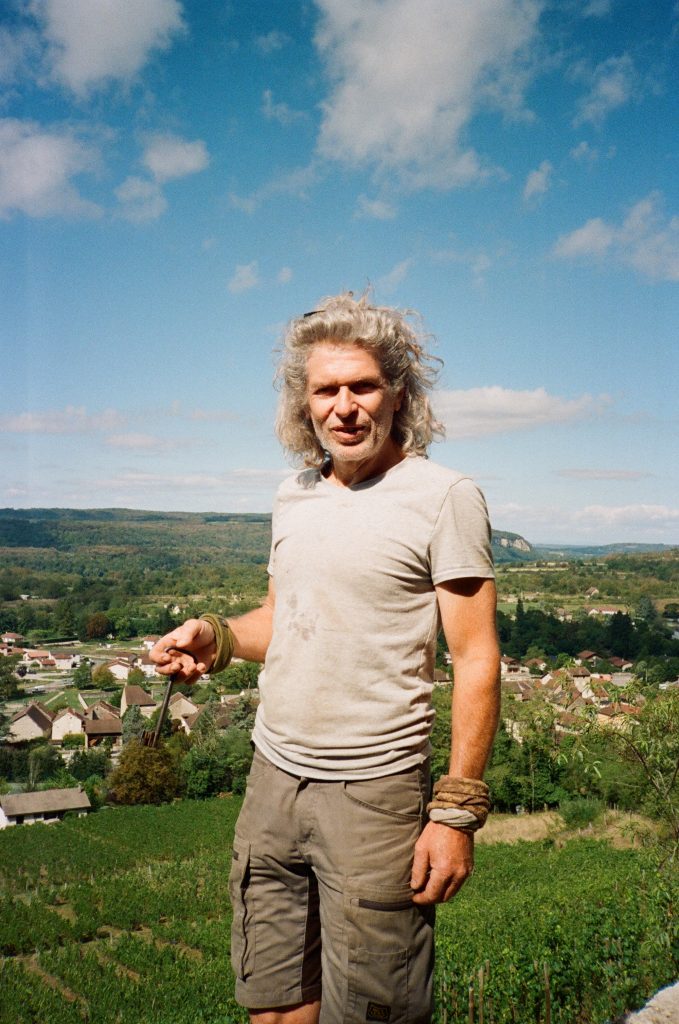
Francois Grinand’s family — like many in French viticultural regions — owned vineyards and made wine for generations. His father was a vigneron but was a wine enthusiast rather than a professional. He tended vines and made his own wine on the side, as the elders always had. His father did, however, expand the vineyard size and re-plant parcels in the 1970s, constituting a small domaine of 3 hectares by the 1990s. Francois highlights that his family already owning wines was key to his debut as a vigneron. In the Bugey, the locals have an emotional bond to their land, and there is very little land mobility. Parcels stay in the same family. Even younger locals struggle to rent, let alone purchase them. Some deals often fall through at the last minute in somewhat irrational fashion. This also explains why the Bugey region is lesser known and quite wild: Francois’ vineyard is lone-standing and surrounded by unfarmed parcels and forest.
Francois has inherited a true sensibility for the living world from his father. Like many of his generation, his father did not relate in practical terms to the concept of organic agriculture. However, Francois tells us he had amazing knowledge of nature alongside a natural intuition: he knew what to do and when, though he lacked formal training. Francois received only a small part of this knowledge, yet remains very attached to it. Francois started the formal organic conversion in 1995, and the whole estate has been certified since 1998, though he chooses not to display it on his labels.

Francois’ vineyard in Villebois, Bugey.
Vineyard
When I arrived in Villebois, Francois Grinand’s house was tucked into a small courtyard. He made me a great espresso and grabbed a thick metal key, inviting me to walk to his vineyard. Francois, born in 1966, has reduced the size of his vineyard as well as the amount of vineyard work so he can work alone—something that becomes immediately clear as we climb the steep path towards his parcels. My city-lungs were still out of breath before his. We reached the parcels right at the hilltop above the village alongside a stone wall, and he showed me his holdings. It’s one of the most beautiful vineyards I have seen. To the east, beyond the golden clay cliffs that sit atop Francois’ vineyard, are the Alps, and in the west the Rhône meanders through the plain before taking its final southern turn through the city of Lyon. Almost fully isolated, with only neighbours being the natural wildlife that can make a habit of taking its August breakfast in the vines.
The soils of vineyards in the Bugey are mostly made up of calcareous scree and glacial till. The parcels are usually found underneath cliffsides. This type of landscape is called “Piémont,” or literally at the foot of the mountain, like the Italian region of the same name. Due to the relative altitude of the vineyards—between 350m and up to 500m—the Bugey parcels are planted steeply and often with southern exposure. In contrast with many French viticultural regions, parcels have stayed small in the Bugey. They sit close to the forest and are too steep to mechanise. Some of the soil work can be done with a pulley system, but other than that, all work is historically done—and remains—done manually. The tilling is complex: young vines suffer from competition from some grass species, but the deep soil work needs to be gentle enough to maintain its integrity. Working the soil too hard or too deep might dry it out, and with heavy rainfall it will erode. Nowadays, Francois farms each parcel based on his intuition. Recently, he has favoured mowing and cover crops, though he does not exclude light soil work if needed.
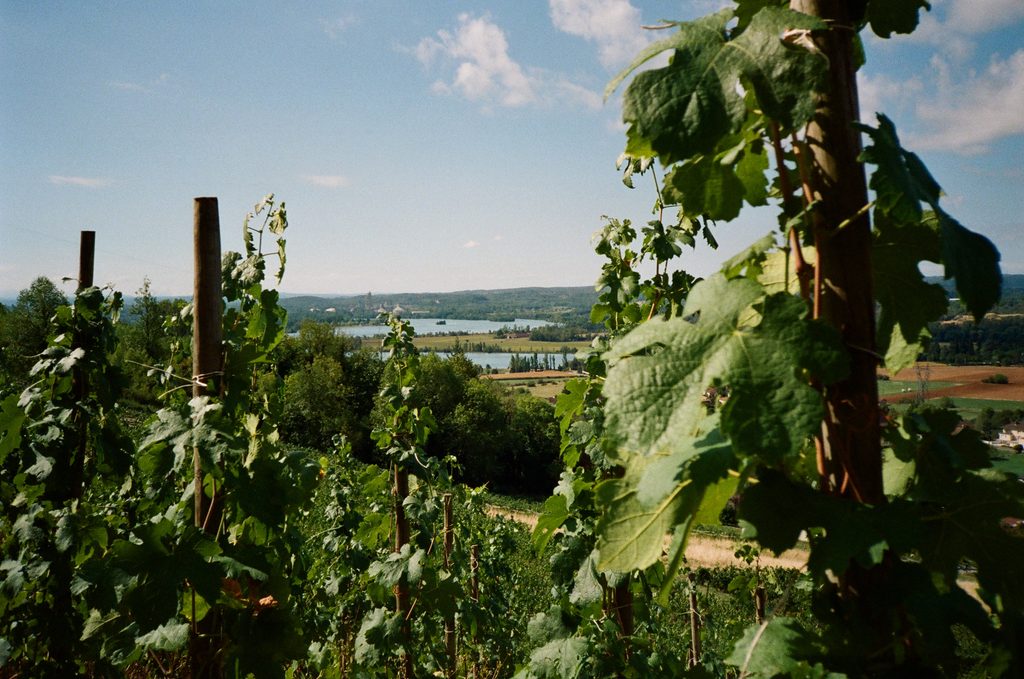
Roussanne on échalas, with the Rhône valley visible beyond.
The vineyard is planted with a myriad of varieties, which is typical of the Bugey, a region at the crossroads of the Rhône, the Beaujolais, Savoie, and Jura. Francois farms Mondeuse, Gamay, Pinot Noir, Chardonnay, Altesse, and recently planted some Roussanne on échalas. The Altesse and Chardonnay were planted in 2003 and 2005, while the red varieties go as far back as the mid-1970s. The limestone soil is quite similar overall, but the whites are planted where there is a bit more clay “à fleur,” meaning on the topsoil. In the middle of the vineyard sits a willow that provides shade and has provided organic material useful for viticulture in the past—to bind vine canes, for example. Francois pointed out that vines closer to the willow, which provides shade and reduces the effect of hydric stress, suffered less from the 2026 heat and provided better fruit, which is in turn easier to vinify. He quoted La Fontaine on the matter.
Je le récuse aussi. L’arbre étant pris pour juge,
Ce fut bien pis encore. Il servait de refuge
Contre le chaud, la pluie, et la fureur des vents ;
Pour nous seuls il ornait les jardins et les champs.
L’ombrage n’était pas le seul bien qu’il sût faire ;
Il courbait sous les fruits ; cependant pour salaire
Un rustre l’abattait, c’était là son loyer ;
Quoique pendant tout l’an libéral il nous donne
Ou des fleurs au Printemps, ou du fruit en Automne ;
L’ombre, l’été, l’hiver, les plaisirs du foyer.
Que ne l’émondait-on, sans prendre la cognée ?
De son tempérament il eût encor vécu.
A tree was next the arbitrator,
And made the wrong of man still greater.
It served as refuge from the heat,
The showers, and storms which madly beat;
It grew our gardens’ greatest pride,
Its shadow spreading far and wide,
And bow’d itself with fruit beside:
But yet a mercenary clown
With cruel iron chopp’d it down.
Behold the recompense for which,
Year after year, it did enrich,
With spring’s sweet flowers, and autumn’s fruits,
And summer’s shade, both men and brutes,
And warm’d the hearth with many a limb
Which winter from its top did trim!
Why could not man have pruned and spared,
And with itself for ages shared?–
Extract from L’Homme et la Couleuvre, Jean de La Fontaine, Livre X, Fable 1 (1679).
Extract from The Man and the Adder, Jean de La Fontaine, Book X, Fable 1, trans. Elizur Wright (1886).
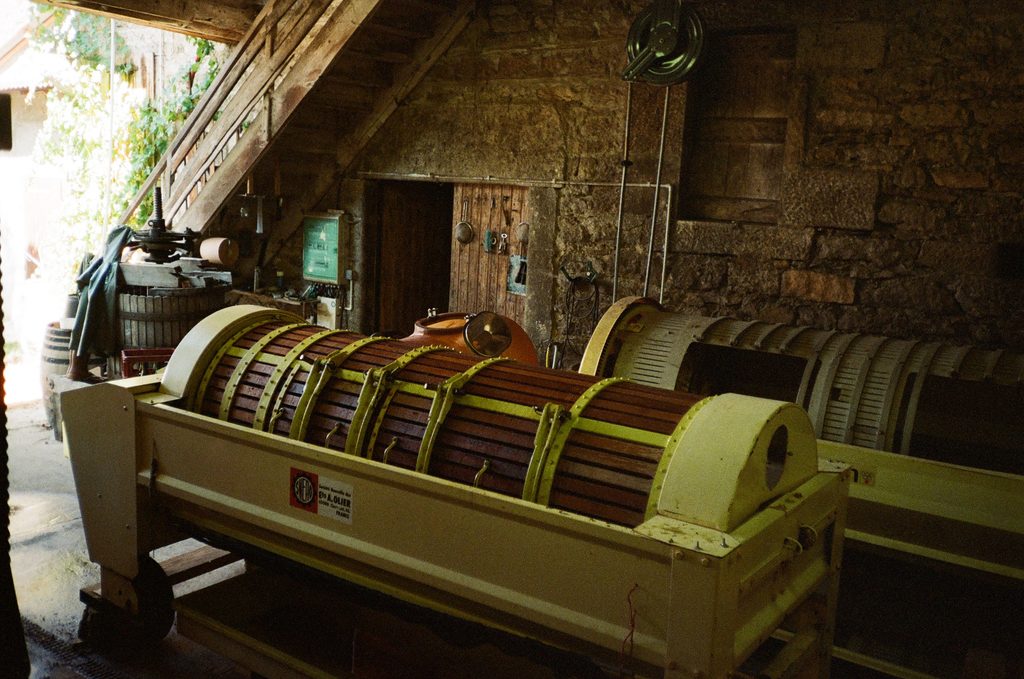
The two horizontal wine press in operation at the chai.
Cellar
The grapes are harvested by hand and brought to Francois’ chai in Villebois. The reds are fermented whole-cluster—except the Mondeuse—in big conical old oak vats. They macerate between one and two weeks depending on the vintage and concentration of the fruit. They are pressed and transferred to oak barrels. Some of the ageing is also done in sandstone amphorae. After 12 to 18 months, they are bottled, usually in the spring during a low moon phase. Whites are pressed directly, without maceration, and ferment in oak barrels.
In recent years, white varieties have shown an unusually high alcohol potential, sometimes going above 15% ABV. This causes fermentation to stall with some residual sugar remaining or a higher volatile acidity. This is specific to the direct-press method, since the skins provide more matter and more diverse yeast. In reds, this brings the ABV lower and fermentations are healthier. When tasting 2025 whites on barrel, the initial cool temperature in the glass brought complex floral and salty notes. However, as it warmed up in our glass, the VA took over and compressed the delicate aromas of Roussette and Chardonnay. Francois remarked that he does not know how to vinify these vintages. Like many others, he works without a playbook when it comes to the consequences of climate change. We discussed using maceration as a tool to improve balance in whites, if only for a few hours or overnight. As for his whites, my belief is that time would integrate the volatile acidity within the tertiary aromas. A young and vivid wine over-exposes this character, while an aged version will bring out texture and an elegant austerity. We also discussed the only variety that was not yet harvested as of the first of September 2026: Mondeuse. The tannic structure of the stem and the overall loose grape aspect make whole-bunch unworkable. It’s the only variety where late harvest and destemming is standard. Francois also sees potential in future blending with softer red varieties.
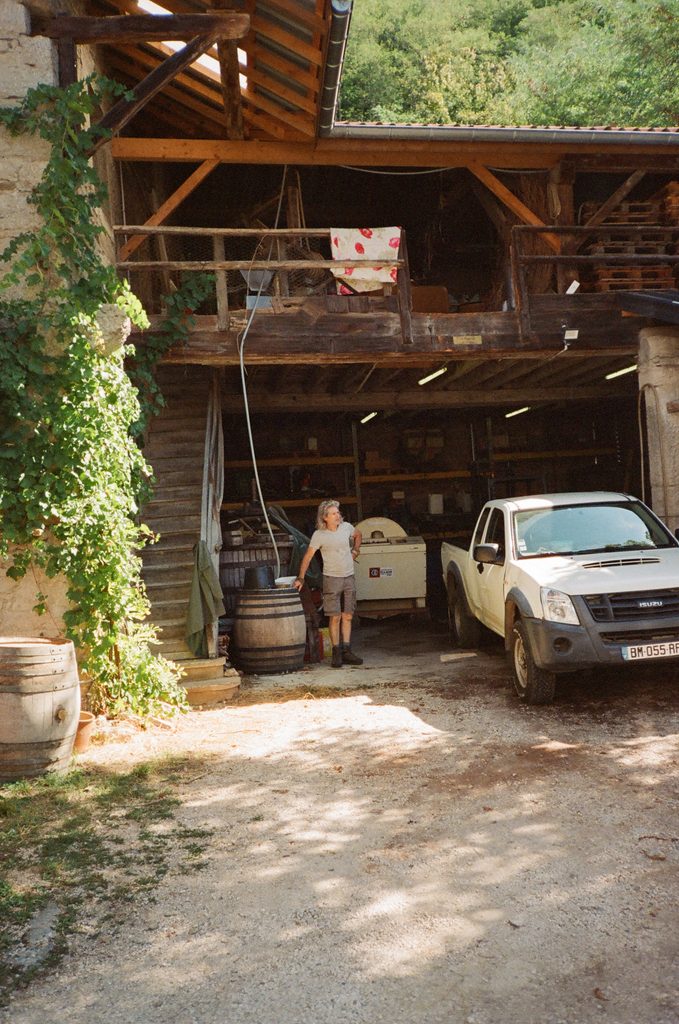
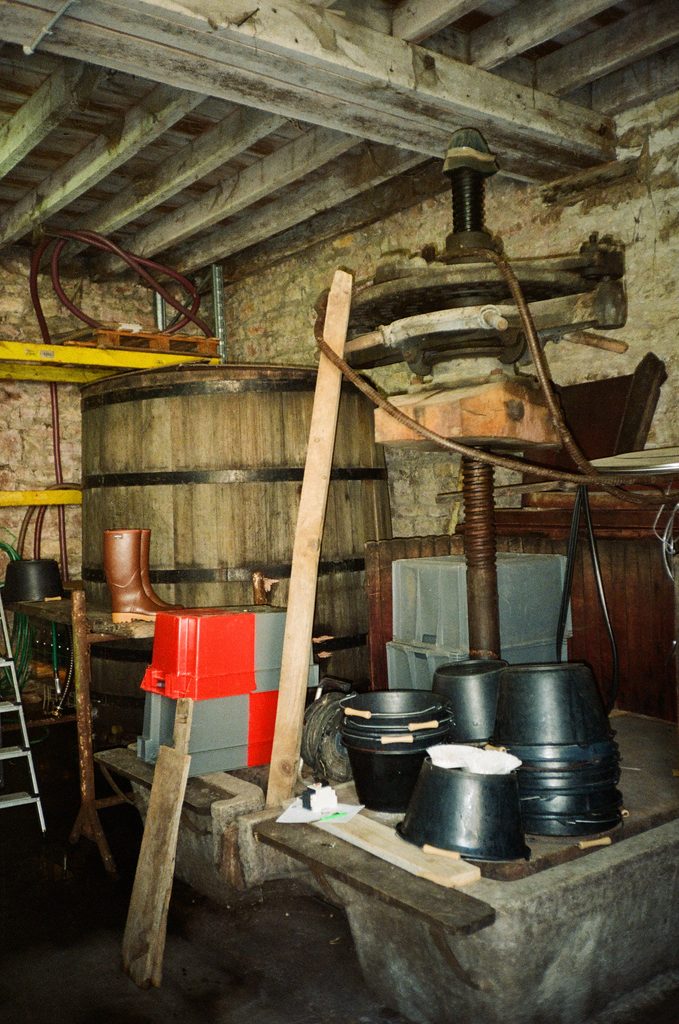
François at his chai (left); the vertical wine press he still uses in daily operation, with a red fermenter behind (right).
Currently, Francois makes two-thirds reds and one-third white, though he aims at reducing his vineyard size and bringing this ratio closer to fifty-fifty. The whites are also commercially stronger in recent years. My favourite of the 2023 release is the Pinot Noir “Les Étapes,” which rivals the best examples of the neighbouring Jura. Crystalline, tart and saline fruit with a tannic depth that brings a little spice. In the cellar, Francois is historically a purist in terms of sulfur usage. He has gotten more pragmatic with age. Pre-2020, he was bottling each barrel by hand without SO₂; now, he blends the lots since he prefers a uniform cuvée. Since this introduces a small bit of oxygen, he protects the wine with 1mg at this stage. The whites don’t see any SO₂, since the lack of tannin, barrel fermentation, and ageing already provide sufficient exposure to oxygen to achieve stability.
“Longtemps un puriste, non souffre. Avec l’âge j’ai mis de l’eau dans le vin.”
Francois Grinand’s wines are true vins d’auteur. They are made in a humble and radically honest way. From the knowledge and land inherited from his father to the new challenges that come with age and climate change, Francois remains grateful and pragmatic. Prior to his life as a vigneron, Francois was a full-time touring pianist. He still uses the downtime in the vineyard to work as a musician, something he has never set aside. He seems to aim at finding balance, refuting stern ideologies and finding truth in the practice itself, whether working in his steep vineyard or behind his piano.


