The Pépin Project
Operated from the Dietrichs’ eco-built winery in Scherwiller, the Pépin team also includes enologists Xavier Couturier and Pierre Sanchez of Duo Oenologie, who oversee production, and Arnaud and Raphaël, who manage daily operations and logistics.
Pépin functions as a négociant, partnering with independent growers across Alsace. These growers farm organically and often begin vinification on-site. Once the wines are stable, Pépin steps in to guide élevage, manage blending if needed, and handle bottling. Many cuvées remain single-grower from start to finish. When blending occurs, it is only between finished wines—done solely to build volume or refine balance while maintaining the overall house style.
This cooperative structure allows Pépin to empower small growers while extending the Dietrich family’s natural-wine ethos beyond the boundaries of their own Domaine.
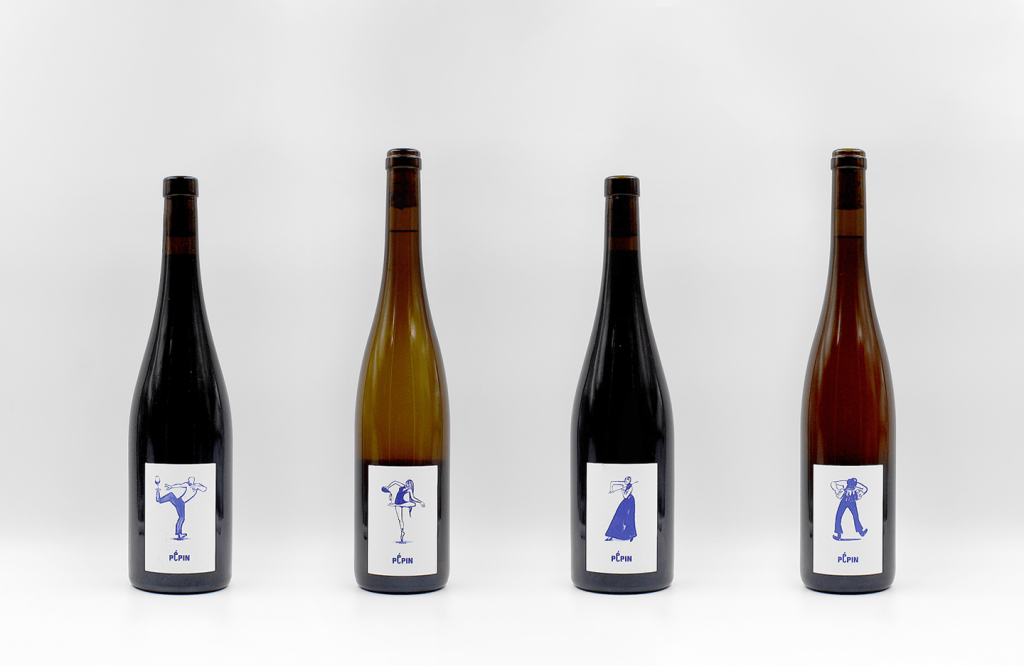
The line-up of Pépin: Pinot Noir, Blanc, Rouge and Orange
Philosophy
The name “Pépin,” meaning “seed,” reflects the project’s aim to cultivate good farming, strong community, and small beginnings with lasting impact. Pépin works exclusively with growers who farm without chemicals, harvest by hand, and value transparency.
The Dietrichs reject the idea that scale requires compromise. Pépin wines are democratic and approachable, yet made with precision and integrity. Each bottle is intended to be alive, expressive and easy to understand, without ever diluting authenticity or depth.
Harvest and Cellar
All grapes are hand-harvested from organically or biodynamically farmed vines. Fermentations are spontaneous, driven by native yeasts, with no additives: no commercial yeast, no fining, and no filtration. Reds and orange wines undergo skin contact, while whites are generally direct-pressed or briefly macerated depending on vintage. Ageing takes place in neutral vessels such as stainless steel, old barrels, or large Alsatian foudres to preserve freshness and fruit clarity.
The wines are bottled unfiltered and often retain a light touch of natural CO₂, a soft prickle that serves both as preservative and hallmark of vitality. Very small quantities of sulfur may be used when necessary.